Solar Irradiance technology
Loading...
Solar Irradiance technology
OpenWeather’s Solar Irradiance and Solar Panel Energy Prediction services provide solar radiation data and estimates of photovoltaic energy generation for projects of any size. They combine established scientific methods with OpenWeather models and data through APIs designed for straightforward integration.
Solar irradiance and solar irradiation are closely related, but describe different quantities:
Solar irradiance · W/m²
Solar power received per unit area. The API provides average and maximum irradiance for the requested interval.
Solar irradiation · Wh/m²
Total solar energy received per unit area over a specified period.
Multiply the average irradiance over an interval by the interval’s duration in hours:
Irradiation (Wh/m²) = Average irradiance (W/m²) × Interval duration (h)Example at 400 W/m² average irradiance:
Interval | Duration in hours | Irradiation |
1 hour | 1 | 400 Wh/m² |
15 minutes | 0.25 | 100 Wh/m² |
Our models provide three key components of solar radiation:
These components can also be expressed as irradiation when accumulated over a specified period. We provide GHI, DNI and DHI for both Clear Sky and Cloudy Sky models.
Our models build on established methods, including Simplified Solis and DIRINT, with adaptations developed for the OpenWeather service and evaluated against ERA5 & CAMS datasets.
OpenWeather Clear Sky model
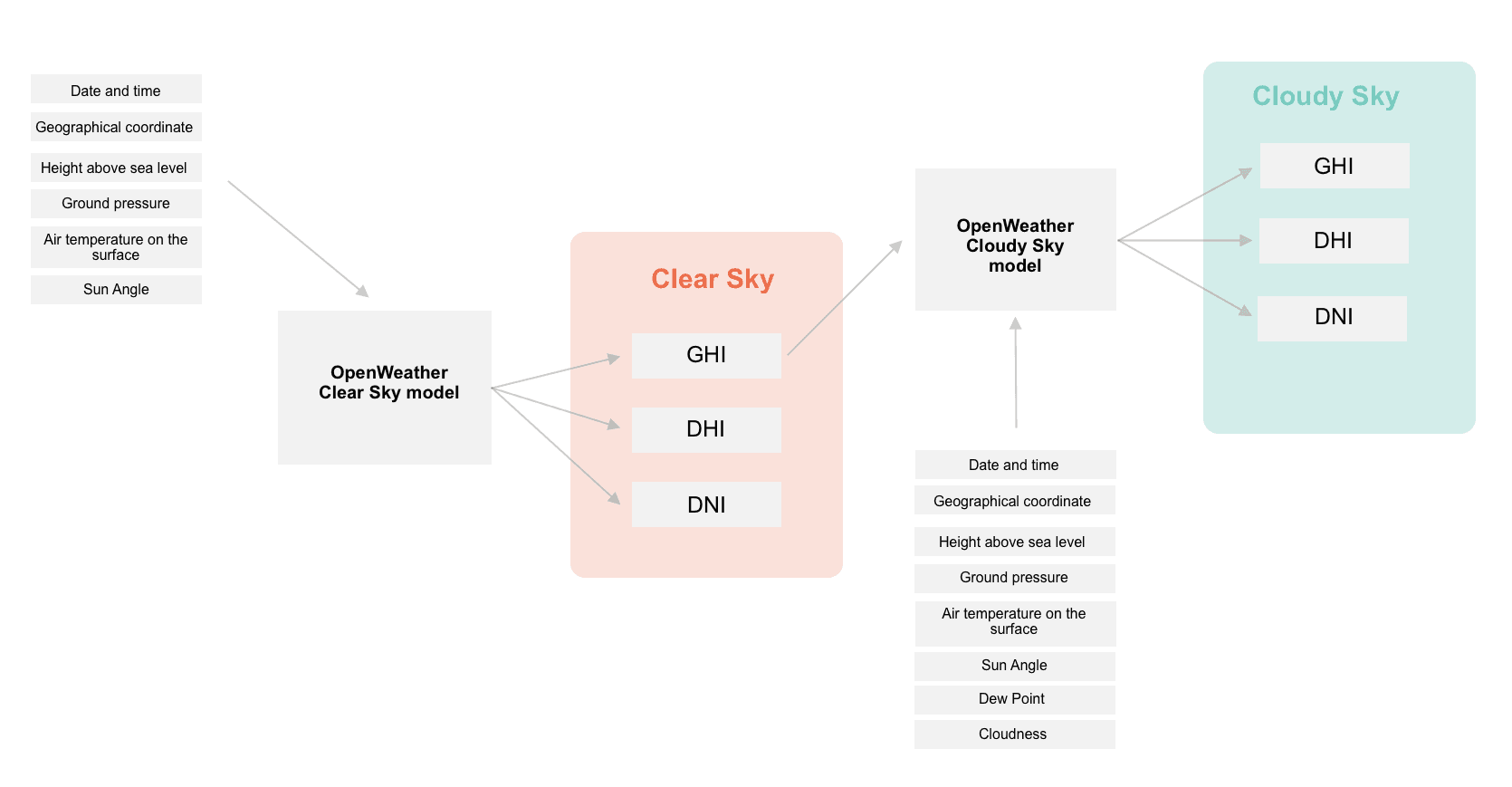
The OpenWeather Clear Sky model estimates the solar radiation reaching the Earth’s surface under cloud-free conditions. It accounts for the position of the sun, site elevation and relevant atmospheric conditions to calculate clear-sky GHI, DNI and DHI.
The model builds on Simplified Solis, with adaptations developed for the OpenWeather service. These adaptations address the timing of calculations within each reporting interval and the treatment of solar angles around sunrise and sunset.
Clear-sky estimates provide a baseline for understanding the solar resource at a location. They also serve as the starting point for the OpenWeather Cloudy Sky model, which estimates the effect of clouds on solar radiation.
The OpenWeather Clear Sky model uses the following data to calculate clear-sky Global Horizontal Irradiance (GHI), Direct Normal Irradiance (DNI) and Diffuse Horizontal Irradiance (DHI):
OpenWeather adaptations
Interval timing. Solar radiation varies throughout each reporting interval as the sun moves across the sky. A calculation made only at the beginning or end of an interval may therefore be less representative of conditions during that period. For hourly calculations, OpenWeather applies a 30-minute backward shift to use the solar position at the interval midpoint. This helps align the solar geometry used in the calculation with the period represented by the returned data.
Sunrise and sunset. Irradiance calculations are particularly sensitive when the sun is close to the horizon. At these low solar elevations, small differences in solar geometry can produce unrealistic calculated values. OpenWeather uses sunrise and sunset times to adjust the treatment of solar angles during these periods. These corrections help limit anomalous values as the sun rises above or falls below the horizon.
The model returns clear-sky GHI, DNI and DHI, representing the global horizontal, direct normal and diffuse horizontal components of solar radiation under cloud-free conditions.
OpenWeather Cloudy Sky model
The OpenWeather Cloudy Sky model estimates the solar radiation reaching the Earth’s surface with the effect of clouds included. It combines clear-sky radiation estimates with cloud information and atmospheric conditions to calculate cloudy-sky GHI, DNI and DHI.
The model uses a cloud-transmittance correction developed by OpenWeather, together with a modified DIRINT approach for estimating direct normal irradiance from global horizontal irradiance.
Clear-sky estimates provide the baseline, while the cloud correction accounts for the reduction in solar radiation caused by clouds.
The OpenWeather Cloudy Sky model uses the following data to calculate cloudy-sky Global Horizontal Irradiance (GHI), Direct Normal Irradiance (DNI) and Diffuse Horizontal Irradiance (DHI):
As in the Clear Sky model, most of the input data is taken from the OpenWeather datasets and products.
OpenWeather adaptations
Cloud-transmittance correction. Cloud cover, expressed as a percentage, is converted into a coefficient representing the estimated transmission of solar radiation through clouds. This coefficient is applied to clear-sky GHI to calculate GHI with cloud attenuation included.
Higher cloud cover generally produces greater attenuation. In cloud-free conditions, the cloud correction does not reduce clear-sky GHI.
Direct and diffuse components. After cloud attenuation is applied, the model uses a modified DIRINT approach to estimate DNI from GHI. Solar geometry, surface pressure and dew-point information support this calculation. The direct and diffuse components describe how the radiation reaching the surface is distributed between direct sunlight and scattered light.
The model returns cloudy-sky GHI, DNI and DHI, representing the global horizontal, direct normal and diffuse horizontal components of solar radiation with the estimated effect of clouds included.
Solar irradiance forecasts
OpenWeather provides solar irradiance forecasts up to 15 days ahead, combining numerical weather prediction data, local correction methods and satellite-based short-term forecasting.
General forecast
The general forecast uses numerical weather prediction data together with the OpenWeather solar irradiance models to estimate GHI, DNI and DHI.
Improved correction methods, informed by local site data, help reduce systematic forecast errors and better represent local irradiance conditions.
Short-term satellite-based forecast
For supported locations across Europe, the Middle East and Africa, satellite observations further improve forecasts up to three hours ahead. Successive satellite images are used to estimate cloud movement and forecast its effect on solar irradiance.
These short-term forecasts are refreshed every 15 minutes as new satellite observations are processed. Longer-range forecasts continue to use numerical weather prediction data with the corrections described above.
Forecast type | Forecast horizon | Update frequency |
General forecast | Up to 15 days ahead | Four times per day |
Short-term forecast | Up to three hours ahead within supported regional coverage | Every 15 minutes |
The interval parameter controls data aggregation: 15m (15 minutes), 1h (one hour) or 1d (one day). This is separate from the forecast update frequency.
The 15-minute refresh frequency applies to the satellite-based short-term forecast. Refresh frequency and satellite observation age are separate: imagery may have been acquired earlier because data delivery and processing take time.
Release notes
11 November 2026 — Satellite-based short-term forecasts and improved historical accuracy
Satellite-based improvements to Solar Irradiance & Solar Panel Energy Prediction for supported locations across Europe, the Middle East and Africa:
28 July 2026 — Improved forecast accuracy
Improved Solar Irradiance & Solar Panel Energy Prediction forecast accuracy across Europe through corrections based on observations from local ground-based measurement stations.
27 April 2026 — Satellite-enhanced solar irradiance algorithm
Released a new satellite-enhanced solar irradiance algorithm supporting Solar Irradiance and Solar Panel Energy Prediction, improving the historical irradiance estimates used by both services for dates from 2020 onwards.